
What exactly is a safe city?
In the wake of a mass shooting, Tucsonans seek a better vision of safety.
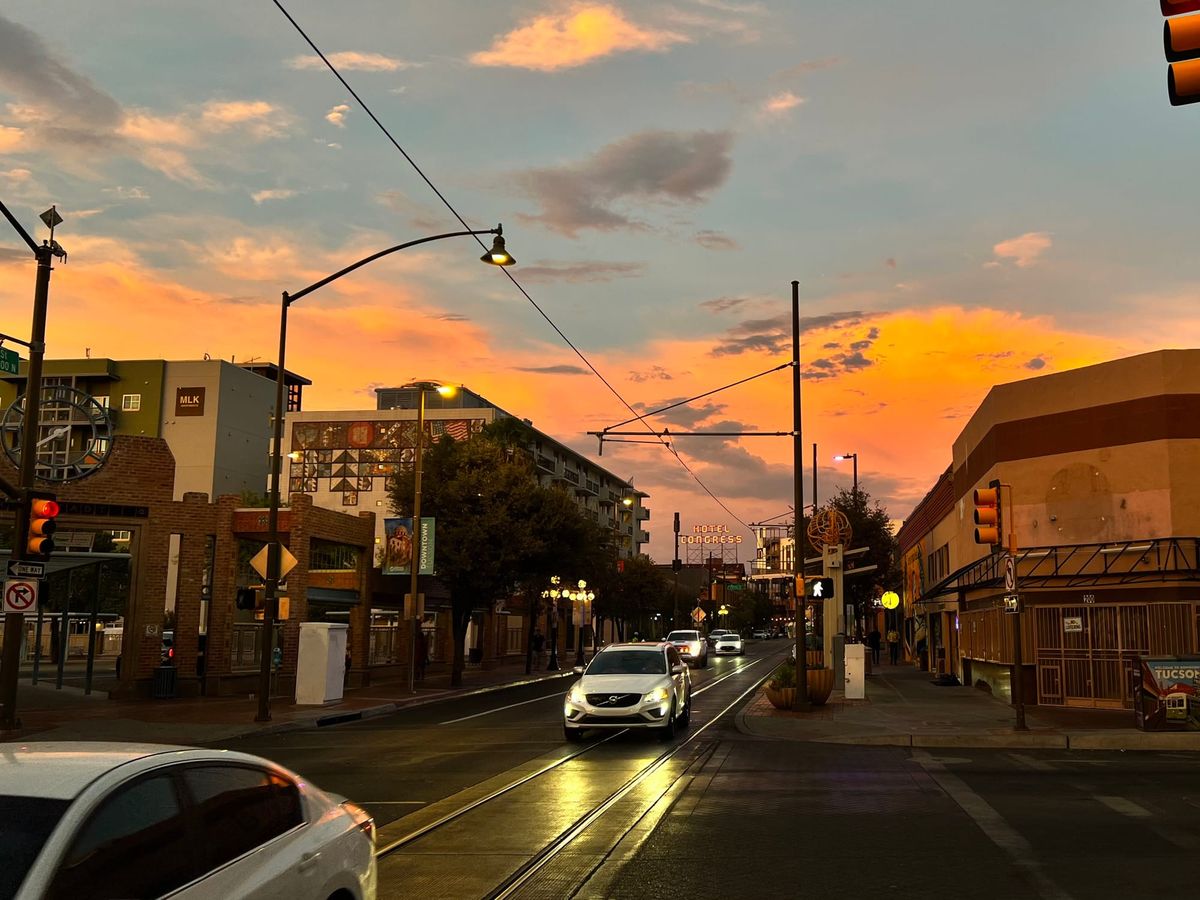
Like most Tucsonans, Jamie and I spent Saturday out enjoying the mercifully cool weather, overcast skies from a wet monsoon breaking up into patchy clouds that made for a perfect afternoon at the pool. That night, we went to see Marc Maron at the Rialto on Congress, the main downtown drag two blocks north of our house. It was a packed show, and the street was lined with people like most weekend nights, including nearly 30 cops in the area that night. Jaime's Pizza was slammed after the show, but we were able to find a table and get some food before heading home around 10.
About four hours later, outside another pizza place a couple blocks down the street, a 21-year-old unloaded several gunshots into a crowd, injuring 9 people before police chased down and shot him.
Miraculously, none of the injuries were life-threatening, but on Sunday morning the rest of the city woke up thoroughly shook, police everywhere and a large chunk of downtown that would otherwise be hosting hungover brunches blocked off as a crime scene. It's all anyone was talking about, and the conversation took a dark turn almost immediately. When the mayor posted a statement praising cops and medics before laying the blame at the state government's weak gun laws, a flood of responses—even from those who support stronger gun laws—accused her of dodging local responsibility in the matter.
Then the social media account of Empire Pizza, where the shooting took place, jumped in to say that gun laws were not the issue, and what makes downtown less safe than other parts of town is "vagrancy, lack of police presence, panhandling, public urination, defecation, open air drug use, graffiti, etc." This led to hundreds if not thousands of comments targeting Empire for assigning blame to petty urban crimes and unhoused people. The next morning, Empire doubled, maybe quadrupled down, with an unhinged and confusing online rant of right-wing talking points and hysteria over journalists suppressing crime rates, free public transit, shoplifting at Walgreens, theft of copper wire, drug use, graffiti, and outdoor vomit and urine. A lot of talk about human excrement. Like, a lot.
The backlash came fast, and the bar owner has been digging away at his own grave since with ongoing commentary, complaining about all the wasted money on social services, the "zombies" downtown, improper use of power washers, and on and on. Phrases like "fuck Empire" and "Empire is maga" and "never going there again" are still ringing in the air.
A few mutual aid groups had been pushing back on the posts, and folks at Community Care Tucson, the group I work with, spent the days after the shooting wondering if we should make some kind of statement ourselves. On one hand, it seemed like people were dismissing if not laughing at Empire's tirade (now sometimes referred to as "the coke rant"), and who really cares about one business owner's opinions out of the dozens who operate downtown. At the same time, there were a lot of people who seemed to be agreeing with the general sentiment—that Tucson is unsafe in part because petty crimes go unpunished. Combine that with Tucson's recently launched Safe City Initiative, which has led to the arrests of hundreds of unhoused people in a matter of months, and we were concerned that things could get even more dangerous around here. Meanwhile, Tucsonans were still clearly rattled by the whole affair, and nothing good was coming out of the discourse. And finally, downtown is CCT's home (also mine), as we hold our weekly events and distributions of resources just a bit south of where the shooting happened. So we settled on the following:
We need to talk about some comments that have emerged surrounding the tragic and scary shooting on Congress.
The owners of the local business where the shooting occurred have opted to direct their anger and frustration at a number of people and issues that have nothing to do with what happened over the weekend. Except guns, which they seem to be fine with.
Their troubling posts reveal less about Tucson and more about their politics, which we don’t care to explore.
Yes, Downtown needs more public bathrooms, on that we can agree. It’s also true that Tucson has problems. They mostly stem from inequality and poverty, but include a housing crisis, cost of living, extreme heat, and insufficient community support for people struggling just to survive. That includes people with substance use and mental health issues.
But let’s be clear: Unhoused Tucsonans are NOT to blame for this shooting and have nothing to do with it. Suggesting otherwise is irresponsible and dangerous.
We don’t even know all the details of the incident, but whenever there is a horrible violent crime, there are always those who immediately demonize poor people and demand sweeping arrests.
The fact is, in recent months, on Mayor and Council’s orders, TPD has been arresting hundreds of people for petty nuisance charges. Is Tucson safer as a result? Absolutely not. It makes our problems worse, trapping people in cycles of poverty, incarceration, and failing health. It’s counterproductive and harmful, and using a tragedy to double down on it would be a disaster.
Business owners are our neighbors, just like unhoused people. And they have a choice of whether to be part of the solution as compassionate community members, or blame our problems on those who are struggling.
We are fortunate in Tucson, in that so many of our thriving local businesses are committed to helping, not harming their neighbors. Dozens have put up free water stations outside their storefronts. They hold fundraisers and donation drives for mutual aid and other community groups. They call for more services and care instead of flooding our streets with police.
What happened over the weekend was an unspeakable tragedy, and we deeply sympathize with those who were hurt and the employees and patrons who were on Congress that night.
Let’s not turn this tragedy into an excuse to demonize our most vulnerable community members and turn our town into a police state.
Let’s turn it into an opportunity to come together and be stronger as a community, making Tucson truly safer by caring and looking out for each other, and doing what we can to ensure that we all have what we need.
The post went about as close to viral as you can get in Tucson, with around 130,000 views and almost 6,000 likes in one day, making it maybe the most-seen thing CCT has ever put on our page. We have a decent-sized account, but more than 80% of that was people who don't even follow us. I imagine part of the reason it got so much traction is the fact that this was all anyone in town had been thinking and talking about since the weekend, but looking at the many moving responses, it seemed like was something else going on. Several people commented something along the lines of, finally, this is what we needed right now, or this is the discourse the city needs. One person said, "This is the response. The local officials turned this to macro policy argument and frustrated local business owners blamed people who are only looking for and need a helping hand. Thanks for giving us the response we all feel."
I think many of us were feeling this certain way, but couldn't put our finger on it, a sense of being overlooked and misrepresented by both business and political interests in the immediate aftermath of the shooting. It feels as though people in this town are starving for something different, something lost in the murky space between a business owner's rage and a government official's posturing. Meanwhile, we brace for the only outcome that we ever seem to get—an agenda of control and punishment that only makes our problems worse. This tragedy may have been unique to Tucson, this week at least, but as cities across the country find themselves struggling and afraid for a variety of reasons, feeling a rising tide of suffering around them, there is clearly a craving for something better, an alternative configuration of what it means to be a safe and thriving city.
The State of the City
Part of the reason Empire's tirades, as kooky as they were, gained some traction initially is that people can indeed recognize that something is wrong in Tucson, including downtown, and I think there are similar feelings in most American cities right now.
For one, businesses are closing all over town. There are a lot of reasons this is happening, some of which are related to supply chains and global conflict that has sent the cost of some goods through the roof. A local restaurant recently shared that a supplier notified them plastic goods would be increasing in cost by up to 25% as a result of rising oil prices and volatile markets. But underlying all of this is the fact that, increasingly, people cannot afford basic costs of living—rent, groceries, electricity, health care, all outpacing wages. To the extent that business is going well, it's mostly buoyed by the upper tier of consumers, what economists call a K-shaped economy, and what the rest of us call, "a handful of people have all the fucking money."
In addition to storefronts once frequented by the middle and working classes shuttering, there are more people living in a state of financial desperation, and that includes homelessness. The number of unhoused people in the United States has hit a record high, with an 18% increase from 2023 to 2024. Combine that with shocks and stresses created by extreme weather due to climate change, and we are seeing an overall strain on cities that manifests in increased suffering among low-income residents, but also the kind of petty nuisances the Empire guy was whining about. One thing he was right about is that there are not enough public bathrooms, or for that matter, non-business-owned infrastructure of all kinds, whether that's safe places to get a meal, hydrate, wash up, safely use substances, charge your devices, or even sit down and rest for a minute, which makes minor transgressions like peeing in public more common and visible. On one hand, this kind of thing is just part of living in a city, but it doesn't feel good to see masses of people where you live visibly struggling. And for some, it interferes with their own sense of comfort or maybe their ability to ignore social problems so they can go about their day. The mournful chorus of "look at the state of the city" echoes throughout McMansions on the outskirts of the metro area.
Urban struggle and disorder do not mean, however, that we are living in the violent hellscape that some property and business owners would like you to believe. In fact, outside of a Covid-era spike, violent crime remains remarkably low nationwide, including in Tucson, where in 2025 we saw the lowest rates since 2019, including a drop in homicides and gun violence. I lived here back in the 90s when, for the most part, people didn't really go downtown. City centers are in many ways doing far better than they were in the past. But people conflate petty urban transgressions with the occasional violent crimes, which are not causally related, even if they are connected by the same underlying unmet needs.
What that leads to is the solution that Empire and other "tough on crime" advocates in the city always call for, which is more policing, more arrests, more incarceration. When Empire was being publicly shamed, some defenders responded, oh they're not literally blaming unhoused people for the shooting, they're saying that the unhoused and related nuisances create the environment in which violent crimes are likely to occur. Which is kind of tomato/tomato if you ask me, but is essentially a tired, debunked approach to city management called "broken windows theory," for which we can partially blame the beloved writer of horrible books Malcolm Gladwell. The smartypants hypothesis that general disarray in an environment leads people to commit violent crimes is enticing, so much so that it prompted a renaissance of racist and harmful stop-and-frisk law enforcement and other forms of over-policing, notably in New York under Giuliani and Bloomberg.
In the years since broken windows and stop and frisk saw a surge in popularity, both have been thoroughly disproven, including the perceived benefits of their widespread application in New York. As it turns out, social disarray does not cause crime, and over-policing does not stop it. And yet, just as the Reagan-era war on drugs is somehow resurgent in 2026, these ideas have risen from the grave in deep blue American cities—including right here in little old Tucson.
For City Government, Safety Means Handcuffs
It's a hard time to be a liberal government official, because seemingly nobody wants the solutions they have to offer. In Tucson, our self-described progressive Mayor and City Council are loathed by the right and much of the center for being soft-on-crime libs wasting money on social services. And from the left, we see below a carefully cultivated facade of compassion a regime of criminalization and policing of the poor that would make Donald Trump proud.
With one hand, they offer services and resources—often exaggerated claims of outreach and available services, but in some cases legitimately helpful programming—and with the other hand, they bring down the full hammer of law and order, smashing any progress they otherwise may have claimed. My friend and fellow organizer Liz Casey has a good way of describing this, which is that when politicians carry out right-wing policies but pretend they are progressive solutions, and then those policies fail as they are destined to, everyone hates progressive solutions.
This has been going on for years in Tucson, driven by a snitch hotline that has led the city to spend millions of dollars destroying homeless encampments, sending already unstable people's lives into further chaos and destroying the few precious possessions they may have (birth certificates, photos of loved ones, legal IDs). But the strategy has really come into its own with the Mayor's signature Safe City Initiative, which she unveiled in late 2025. It's the ultimate example of wrapping up cruelty in a shroud of care, claiming to be an outreach initiative, but overwhelmingly yielding mass arrests for petty crimes.
To be (a little) fair, the initiative and its precursors do offer resources to unhoused people, and some do get them. But the large majority face criminal charges instead. The mayor will often point to declined services as a way to wash her hands of the arrests and blame the arrestees, but people decline for many legitimate reasons, including strict controls and unsafe conditions that often come with them. But also, and something we hear frequently from unhoused folks, is that they have zero trust in the City of Tucson, the threat of arrest for some years-old panhandling charge far outweighing any potential benefit. And who can blame them, when an outreach effort looks like a pack of uniformed men with guns, a huge police RV, a mobile court for fast sentencing, all surrounding a little card table of outreach workers and some flyers. The true harm of this initiative is on display in the numbers. As Yana Kunichoff at Arizona Luminaria recently reported:
Data from a recent outreach effort shows that in four months this past winter, police made 360 contacts that resulted in 328 arrests with 1,097 total charges that include 332 misdemeanors, 68 felonies, 345 misdemeanor warrants and 24 felony warrants. ... They also facilitated 29 shelter placements, 26 detox acceptances and 15 medical-assisted treatment referrals.
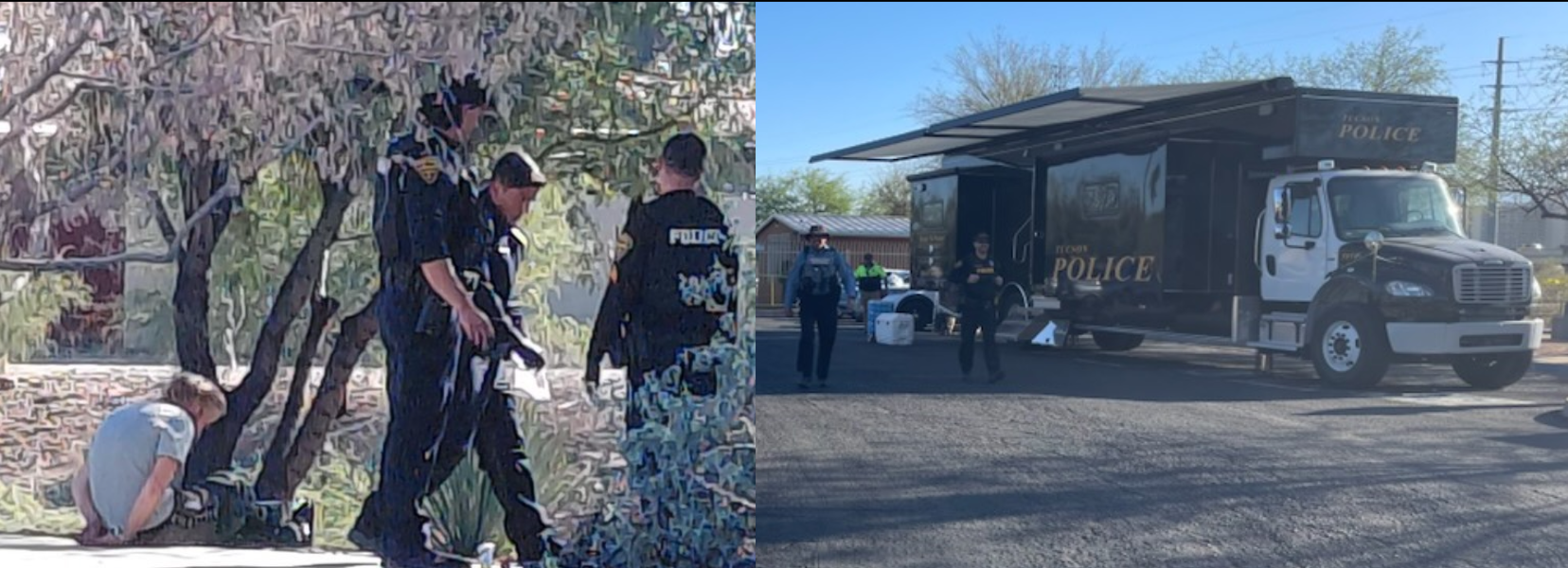
If the goal of the Safe City Initiative is to put hundreds of vulnerable people in handcuffs for mostly petty offenses, it is a smashing success. If the goal is to help people with social services, it's a disastrous failure. In other words, either they are doing something very wrong as an outreach effort, or they are doing something very right as a program of mass arrest.
In that same article, AZ Luminaria reported a new weapon in TPD's arsenal, which to a non-expert, seems like it cannot possibly be legal. The police department is using an internal algorithm to make a list of 50 individuals "most often convicted of trespassing, loitering and being caught with drug paraphernalia to offer them additional services. But if they refuse or reoffend, it could mean harsher criminal penalties." Officially given the Orwellian title Focused Deterrence Quality of Life Initiative, the pilot project sounds an awful lot like a hit list of people who have been charged with petty nuisances in the past, which cops can use to first tail and harass them, and then lock them up for longer than they would otherwise be able to, what TPD is calling "enhanced criminal justice accountability." I'm not a lawyer, but I think the legal term for this is profiling, or as I like to call it, "some real Minority Report shit." Whatever you call it, whenever people in positions of power start making lists, we should all be very worried.
The tragedy of these types of programs, on top of the tremendous harm caused to individuals and immense waste of public resources, is the fact that they don't work. In fact, they make things worse. There's extensive research showing that punitive tactics do not curb homelessness, and only make it harder for people to find stability. Policing and punishment of the unhoused lock people into cycles of incarceration, poverty, and addiction, and even increase likelihood of death from overdose. The shelters that these sweeps attempt to funnel people into are designed for emergency short-term housing, large congregate shelters that for many are unsafe and don't help people transition to stable housing. One comprehensive study found that punitive policies don't even achieve their short-term goal of removing people from the street, creating a "spatial churn" that merely pushes people from one location to another. One human services agency director in San Francisco referred to encampment sweeps as "a colossal waste of city resources" and a "colossal waste of time." When services are offered alongside the threat of arrest, what Tucson calls "leveraging arrest," it's a form of forced treatment, another dated and dangerous tactic that is not backed by research and drug treatment advocates consider unethical.
What meager sympathy I have for our local politicians lies in the fact they are under tremendous pressure from the public to do something, leading them to false solutions. Even city councilors whose stated values are not aligned with punitive strategies can't or won't stop them, like they've become these components in a machine that is not built to do what they might want it to do. There are, of course, things city officials could do, namely stop arresting hundreds of our people, but also infrastructure-related solutions that we've advocated for like safe use sites, trash cans, public bathrooms and showers, and obviously affordable housing. But I'm always skeptical they could effectively carry out real solutions, politically, but also structurally, as anything they seem to do in this space is inevitably bureaucratic and paternalistic, ending in yet another form of control. And when it comes to addressing the underlying poverty and inequality that are at the root of these problems, not to mention climate change, local politicians are highly limited, mostly serving as mere middle managers to capitalism.
It's notable that the Mayor's second attempt at a statement following the shooting thanked the police and then pleaded with the city's money-spenders to please, please spend money at downtown restaurants we need you all to spend money. Because at the end of the day, even when their constituents are being put through a meat-grinder, all they can offer us is control and commerce.
What Exactly Is a Safe City?
I realize I am throwing a lot at you here. I don't mean to use a tragedy to unload on all the bad things that I think the city is doing. But this shooting has kicked up a lot of discussion around harmful ideas and approaches to making a city safe. I do not have all the answers to violent crime in Tucson. It's horrible, and this shooting was horrible. But we do know a lot about what does not work, including punitive strategies for city safety, and what does work.
I think people often mistake mutual aid groups as these overly idealistic leftists, throwing marshmallows at serious problems, but what we do is just as much if not more about effective strategy as it is ideology. And while mutual aid is not the solution to all of our problems, after spending years dealing with large numbers of people struggling with very challenging situations, I do know that when people's needs are met, in the vast majority of cases, conflict simply evaporates. When people are suffering from heat exhaustion, they fight. When they cool down, they stop. When people are starving, they steal. When they have food, they don't. Every night we set up a distribution, we see what happens when you create even a small pocket of abundance, respect, and freedom from oppression. When we talk about what it really means to be a safe city, that's what we're talking about—one in which people have what they need and are not under constant attack from people in power. What we do is far from perfect, but it can be a little glimpse of paradise.
I also know from the aftermath of this tragedy that people are frustrated and scared and angry, but a huge number of us are very obviously ready for something different, a new definition of safety that doesn't involve men with guns or political posturing or pleas to just keep spending money. For every Empire Pizza, there are so many businesses and individuals who are recognizing that they need to be a part of that alternative, and many have been speaking out and saying as much in the past few days. We are starving for something better.
There’s a sentiment that we sometimes hear from critics of mutual aid, and even some people who work within mutual aid, that what we do is just a band-aid, an unfortunate but necessary patch for a government that should be taking care of us. But for most of us, it's something different—a model for a better kind of safety, created by all of us. I'm under no delusions that our little collective or any one of the others in town is going to swoop in and save the city or end crime and homelessness. But the principles that guide us—liberation and care instead of control and punishment, solutions created by and for our community, activating inclusive public spaces—can point us toward a path that just might get us there. In the meantime, we'll be downtown, out in the park, doing what we do.