
Terror on the outskirts of Eddington
Ari Aster's near-masterpiece generates all the horrors of 2020, but the big bad is a bloodsucking data center in the desert.


Today we are doing an old school Crisis Palace movie review and analysis, taking a hard look at Ari Aster's 2025 epic western/horror/satire Eddington. We're diving into the world Aster created, or recreated, to many viewers and critics' great dislike, and what exactly we should take away from it. Especially when it comes to the film's central concern over the tech industry's accelerating colonization of our lives, and its meatspace manifestation—the data center.
This is particularly relevant to the Tucson area, as we spent much of the year this movie was released fighting the construction of several massive data centers in our own community, which we won, then lost, then won, then maybe lost. Our fight and the fictional fight in Eddington have become a national one unfolding on many fronts, as communities nationwide resist both the infrastructure that drains our water and energy, and the purported consumer product they create—AI, which is a different kind of drain on humanity. Spoilers ahead, but honestly, it doesn't matter because nobody can agree on what they watched when it's over. Here's my read.
Terror on the outskirts of Eddington
Tate Williams
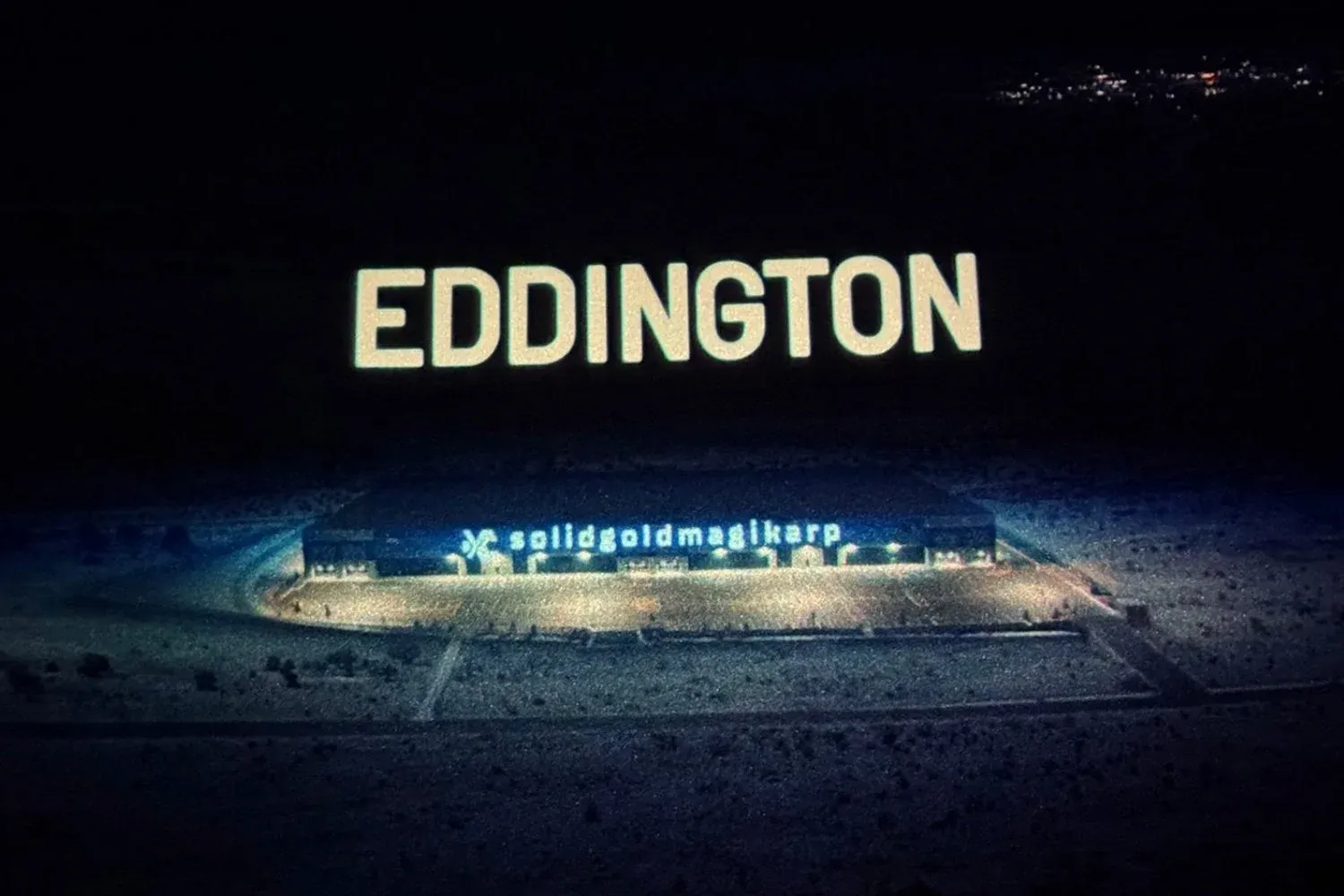
For all of the dizzying chaos and ambiguity of Ari Aster's almost-masterpiece Eddington, a 149-minute caricature of America in the depths of 2020, there are two shots that are crystal clear.
The very first one, in which a mentally ill man stumbles on the outskirts of a small New Mexico town past a sign warning, "proposed hyperscale data center development." And the very last one—the data center in question now born into existence, glowing with power in the foreground while Eddington itself lies sleepily in the distance. While the data center plotline may get relatively little screen time in the nightmare that unfolds in between those shots, make no mistake, this is the story at the heart of Eddington.
It's not that the many things that happen in the interim are meaningless, but the key to understanding it all is to consider the ways in which the internet brought out the worst of us in 2020, and how at the end of the day, all of the political forces jockeying for power were serving the industry, the only real winner.
Tech is the big villain here, not because it's the only villain, but because it acts in the same way as Dracula or Nosferatu, manipulating the darkness within nearby villagers to accommodate for its arrival. All of the politics and pandemic and social tensions are there, and they are real, but filtered through our isolated exposure to the 2020 internet, which makes all parties their worst selves. And though some behave far worse than others, in the end, they all ultimately serve the dark master.
Audiences and critics alike had a tough time with the chaos that unfolds along the way. Eddington's $25 million budget only drew $13 million from the box office, and critics were... mixed. Actually, lots of them absolutely hated it. As did many viewers, including many Ari Aster fans. Detractors found it to be an overloaded mess trafficking in both-sides-are-bad political potshots, whiny anti-woke sentiment, and skeezy male posturing. While there is some truth in all of this, I think these criticisms are biting down too hard on Eddington's bait, and perhaps misreading Aster's intentions, mainly because any message we are to draw from this movie is swimming in a disorienting simulation of what it felt like to be alive in that time, and to some extent what it has never stopped feeling like.
That said, Eddington rewards a rewatch, and though it's a hard sell that if you found a movie painful and annoying the first time you should give it another two and a half hours of your time, I think appreciation of this film will grow and it will eventually be considered a sort of Dr. Strangelove or Catch 22 of this fucked up era we live in.
Live through this
A big part of the reason I think people struggled with what Aster was trying to say with Eddington is that he clearly did not want to make a polemic. But also, there are arguably three missions this movie is trying to carry out, and they often obscure each other. I'll just tell you what I think they are, no reason to be coy: one is synthesizing the awful feeling of 2020; two is casting sufficient blame on the tech industry for creating that feeling; and three is skewering the way a certain kind of insecure man transformed in response.
The first mission takes up most of the first half of the film, in which we are thrust into the setup—the pandemic and Black Lives Matter take hold seemingly overnight in the small town of Eddington, New Mexico, while in the background a massive data complex is slated to be built on the outskirts of town. Joaquin Phoenix's Joe Cross, a MAGA-leaning sheriff, and Ted Garcia, a self-serving incumbent mayor, fight for control of the town.
The early depiction of 2020 is where we experience Aster's genius as a filmmaker, the ability to induce a state of mind in his viewers. He is very good at making us feel a certain way. In his preceding film, Beau Is Afraid, we live the nightmare life of a man with crippling anxiety. In Eddington, the feeling he creates is a mix of confusion, a self-centered sense of persecution, and a loss of control. We are made to relive the 2020-era dissolution of shared reality.
The pandemic vibes are real—maybe too real. The eerie emptiness of the streets, spaced out lines to buy food, the constant reminders to mask and social distance paired with the constant failures to mask and social distance (there are so many noses hanging out of paper masks in this movie). There's also a feebleness of institutions people once leaned on for security, whether it's Eddington's comical three-man police force, bumbling zoom city council meetings, or the mayor declaring the bar is his office because anywhere the mayor is, that's the mayor's office. Nothing feels legitimate anymore.
The other way this plays out is through a relentless barrage of opinions, fueled by each person's individual online experience. Whereas Beau Is Afraid creates ambiguity through an unreliable main character's perspective, Eddington creates ambiguity through an unreliable environment, one in which the characters cannot believe what they see or hear, but neither can the viewer. Everyone is speaking with certainty, but things that are real are presented with the same authority as conspiratorial nonsense. In this regard, Austin Butler is a highlight as a QAnon-like guru, giving glassy eyed monologues spoken in the tone of truth, but saying words that make no sense.

This section also rubbed people the wrong way, especially if they were hoping for a full-throated MAGA takedown, because many of the funniest political moments target the left and Democrats. There are some irritating anti-woke vibes here, but ultimately a lot of the jokes are on point. Pedro Pascal's cuddly liberal mayor is often played for comic effect as he pushes hard to hand over his town to the data center developers, hollowly tacking on a reference to racial equity in a campaign ad in which he, for some reason, plays a piano in the middle of the street. For people living in small blue dots, his pandering on social issues and fixation on economic development will feel extremely familiar.
When BLM erupts, the town's youth become overnight experts on racial justice with little real understanding, one teen googling Angela Davis moments before entering a conversation. I don't think they are meant to be the bad guys here, although some of the young men are notably using the issue to win over girls. The absurdity comes not from George Floyd's murder or the struggle for racial justice, but from the breakneck speed with which many Americans were engaging with these concepts, often in a superficial way. Everything is happening so fast, and we get this explosion of information and opinion being fired back out in every direction, constantly.
One criticism of Eddington is that it is cynical, portraying all political opinions as equally stupid and silly. But there are truths out there in this soup of delusion, whether it's coming from overly earnest BLM protestors or even Sheriff Joe himself, who rightly criticizes Mayor Garcia for being beholden to industry and his own political aspirations, reflecting the strain of justified anti-elite sentiment that runs through MAGA. But there also lies, many lies. It's not that nothing matters and everybody is wrong, but whether something is wrong or right, it sounds the same, and deafeningly loud.
Trick mirror
The one entity that is most certainly wrong in this movie is the internet, or more specifically, the tech industry. It poisons Eddington's minds on the front end, and then makes them pay dearly to sustain the servers that make its trickery possible.
For those looking to defend the internet, especially its use as a tool of activism, which I get, I think the larger critique here is not just the concept of online communication, but the absolute colonization of our minds by an industry that feeds off of our attention. It gives us what we think we want until we can't look away.
People are constantly looking at screens in this movie, and everyone's screen looks different. When coming up with campaign slogans, one sheriff's deputy who is always listening to podcasts about bitcoin, out of nowhere, says we have to get the community on the blockchain. Joe's screen is mostly MAGA fearmongering. One teen sees a mix of half-naked ladies, warnings about murder hornets, and Black Lives Matter posts. The most extreme example is Joe's mother-in-law Dawn, mother to Emma Stone as Louise, who is bombarded with conspiracy theories, which she regurgitates in between her longings for a better time when her husband (hinted as an abuser of Louise) was sheriff prior to Joe. When not staring at screens, everyone is recording to their screens, creating a sense of 24/7 surveillance, all of us being constantly turned into internet.
Eddington's critique of the internet and what it does to us brings to mind Jia Tolentino's 2019 book Trick Mirror, where she set out to do the work that Aster seems to have taken up.
I’ve been thinking about five intersecting problems: first, how the internet is built to distend our sense of identity; second, how it encourages us to overvalue our opinions; third, how it maximizes our sense of opposition; fourth, how it cheapens our understanding of solidarity; and, finally, how it destroys our sense of scale.
Every one of these problems is on horrible display in Eddington, as each individual's worst impulses spill out into the reality of the town: their personalities exaggerated, their certainties absolute, their ideological connections paper thin, their hostilities always at a fever pitch, and their perspectives always at the center of the universe. Tolentino calls this the "everyday madness perpetuated by the internet," a product of forever looking at others and forever being looked at.
It’s as if we’ve been placed on a lookout that oversees the entire world and given a pair of binoculars that makes everything look like our own reflection. Through social media, many people have quickly come to view all new information as a sort of direct commentary on who they are.
Joe Cross's breakdown is instigated in part by someone on Facebook calling him the only good man in Eddington, and deeper into it he seems to have bought the story, as he yells to Dawn, "We are the center of it right now! We are in history."
And then there's the data center. To Aster's credit, he was clearly thinking a lot about these monstrosities long before they rose to national attention during the year this movie was in theaters. The details of the center in Eddington are remarkably true to life, down to the secret annexation of county land, the non-disclosure agreement preventing the town from knowing what exactly is going to happen, and the false promises of sustainability.
In Tucson, a menacing proposal known as "Project Blue" rose to the city's attention when a county supervisor blew the whistle on an annexation deal that was intended to go forward without public input. Of course that same supervisor, liberal Democrat Matt Heinz, threw his full support behind plan not long after expressing concerns. Heinz later said in an interview that Tucson Mayor Regina Romero, another liberal Democrat with remarkable similarities to Pascal's Ted Garcia, had been orchestrating the development behind the scenes for years before it came to his or the public's attention. Dogged reporting from AZ Luminaria uncovered that the client behind developer Beale Infrastructure (a meaningless corporate name reminiscent of Eddington's Solidgoldmagikarp) was none other than Amazon.
The following months were an explosion of community backlash, with meetings packing and overflowing the Tucson Convention Center. The points of contention, aside from general distaste at a reviled tech company coming to town, were the fact that the development was conservatively projected to use more electricity than all Tucson households combined, and would have likely required an entire new natural gas plant to generate the energy. It would have been the city's largest water user, sucking up as much as 7,500 homes, and relying on the desert city's drinking water supply for its first 2-3 years of operation. The outrage was so intense and across a vast coalition that the city government that in part orchestrated the plan had to publicly abandon it. Rejected unanimously by the city council, the project has shambled along like the undead, pivoting to a modified proposal involving only Pima County, complete with a transparently horseshit clause in which the developer will "use commercially reasonable efforts to match one hundred percent (100%) of its energy consumption with renewable energy."
Community groups continue to fight the project, but similar stories now exist all over the country as tech giants spend hundreds of billions to build out this infrastructure. At least 16 projects, worth a combined $64 billion, have been blocked or delayed by local opposition. Recently, 230 environmental groups demanded a moratorium on new construction as evidence grows that data centers contribute to spiking electricity costs, not to mention up to 44 million metric tons of carbon dioxide released annually into the atmosphere all while we hurtle toward catastrophic death and suffering caused by climate change.
And why? To support the self-dealing economic bubble of artificial intelligence, a product that we are all told is inevitable and beneficial, despite its growing reputation for creating reality-distorting garbage. I have dabbled in it, have had a laugh at something it created, and I know people use it regularly, but at this point, it is beginning to look a lot like a deception engine—passing off credibly plagiarized text as its user's own thoughts and words (a city council candidate here recently published an op-ed that was called out for being AI generated), compiling research that is often misleading or flat out wrong, or passing off fake video and imagery as reality. Kyle Chayka of the New Yorker called 2025 the year that this "slop" became close enough to convincing, fooling many of us and being used as political weaponry. If the internet warped our reality as Eddington suggests, the new technology that its data center enables might just shatter it.
MAGA is afraid
You might begin to come away with the impression that, in demonizing tech, Aster "treats his protagonists as automata, manipulated from the outside, devoid of ethical compasses or underlying ideals or prejudices," as Richard Brody did in his review. Irritating if so, and reminiscent of the misguided post-2024 election diagnosis that people did not actually want MAGA, they were just confused because of the media environment. There is some truth in that confusion, but it absolves both mainstream politicians of their profound failures, and many voters of their malicious intent.
That's not how I read Eddington, in which Tolentino's trick mirror distends the characters' identities and amplifies their worst qualities. That's particularly apparent during the second half of the film, when we take a sharp turn from the overall fraying reality of the town, and dive deep into the paranoid rage of its main character. At the midway point, Eddington pivots to a story far more like Beau Is Afraid, but make it MAGA.
If the first half of Eddington is making us relive the experience we all went through, the second half becomes a violent display of what happens when men like Joe Cross experience this new reality. Joe is not without his good impulses, but more than anything he is insecure. About his wife not wanting to have sex with him, much less have a baby, about his incompetent tenure as sheriff when compared to his wife Louise's father, and about a world in which he feels like any control he once had is slipping through his fingers.
His sexual and gender insecurities loom large, leading Brody to conclude that this whole movie is in fact solely about sexual humiliation. But throughout the first half, we see Joe gradually losing whatever pitiful version of power he has in multiple scenarios, rattling him periodically in sync with his worsening covid symptoms. Joe's breaking point is Ted Garcia's mayoral fundraiser, maybe the best scene in the movie, where he responds to a noise complaint and tries repeatedly to turn off Katy Perry's blasting Firework. We share Joe's senses being bombarded by pounding bass and the twice-played line, you don't have to feel like a waste of space, his impotence sealed by Ted slapping him open handed twice across the face.

This is where Joe crosses through the trick mirror like many men have in the last 10 years, and he comes out the other side with his darkest qualities unleashed, a twisted ball of insecure rage. He'll do anything to wrestle back his sense of power. From here, we see key parts of the movie from Joe's point of view, either through his eyes, or over his shoulder like a third-person shooter, as he murders the people in his way and tries to pin it on his young Black deputy, who is maybe the closest thing we get to a moral center.
It's this pivot to Joe's viewpoint that helps explain the most puzzling element of Eddington, the appearance of "Antifa" as an elite, well-funded terrorist squad. Feeding into this narrative is borderline irresponsible considering how some humorless viewers will surely take it. But it is pure satire, a peek into how someone like Joe sees the world in 2020 and beyond. There are different theories on who this group actually is, and while I tend to think it is part of Joe's delusional view of reality, I also like the idea that it is a stand-in for whatever fear has taken over any of us post 2020. They are whatever powerful thing is out there, making the world the way we do not want it to be. NO PEACE, the faceless men declare in fire.
Joe has a Call of Duty-like street battle that ends with a knife plunged into the middle of his skull, and with it, we now see what Joe sees, his vision literally broken into pieces, his view of reality ruptured for good.
We flash forward and, like MAGA, Joe has won his political aspirations in the worst way possible. He's now mayor, but is mostly paralyzed, his mother-in-law now speaking for him in conspiracy theories that have apparently gone mainstream. Though he once campaigned against it, he's now sitting at the ribbon-cutting ceremony for the data center, a helpless tool of the industry just like Ted Garcia. Joe won the political power that he wanted, but the idea that it would put him in control of his fate was a delusion. He's been reduced to a grown baby, capable only of whimpers.
My friend Manny observed that the ending recalls the last season of Fargo, in which Jennifer Jason Leigh's political fixer tells another MAGA sheriff played by Jon Hamm: "You want freedom with no responsibility. Son, there's only one person on earth who gets that deal." To which Hamm's character responds, "the president," and she corrects, "a baby."
If there's any question about what Eddington is saying about MAGA, Joe's fate makes it clear. Violent, insecure, pathetic, ultimately useless. And we all know by now, there is only one real winner in Eddington, and it's Solidgoldmagikarp. The glowing monster that rode this political and social chaos into creation, now sucking the town dry.
And yet, we also see the former deputy that Joe attempted to frame, who has somehow survived an explosion during the firefight, scarred and menacingly filming the ribbon-cutting ceremony on his phone. Just before that final image of the data center in the desert, we see him target shooting nearby with an AR-15, one last warning that the chaos of that horrible year was just getting started.
Links
- OK, all this hating on technology, here is one of the better frameworks I can recall for making peace with the internet—think of it as a parallel fantasy world that runs on different rules and must only be visited intermittently.
- People in Los Angeles were living in storage units smaller than parking spaces with no power or water, paying up to $800/month.
- In New Delhi, home to 30 million people, there is no time or location where the air is not severely toxic.
- The world is on track for catastrophic 2.6C increase in temperatures, and fossil fuel emissions have hit a record high.
- Homeowners all over the country where there's climate-related risk are seeing insurance rates jump by 30% or more every year, while avoiding any claims out of fear of getting gouged. Many are dropping their plans or selling their homes.
- Arizona's jails have become default psychiatric wards, where guards force treatment on arrested-but-not-convicted inmates, often for many months at a time, until they are deemed competent to stand trial.
- Trump's climate policies alone are expected to lead to 1.3 million temperature-related deaths.
- A decade ago, NYC promised to build flood protection for a highly vulnerable neighborhood. The city's spent billions to protect lower Manhattan, but working class coastal areas like Edgemere are seeing no mitigation.
- Self-driving taxis are supposed to be safer than human drivers, but when one kills your cat and drives away, "there is no one to hold accountable.”
- There's been a cottage industry of center-left pundits calling for abandonment of principles to protect principles: abandon trans rights to protect trans people, abandon racial justice to protect people of color, and now dipshit Matt Yglesias says in order to truly fight climate change, we must support oil and gas drilling. (that's not really a link I don't want you to read it)
- As it turns out, the real victim of the homelessness and opioid crisis is wealthy humorist David Sedaris, who was bit by a small dog while shopping in Portland. It ruined his day!
Music
I've been marveling lately at how great Rage Against the Machine was and how this band that was singing about cops being white supremacists was somehow routinely topping the charts. So today, we revisit "Freedom," which is in part about Native American genocide and has a video about Leonard Peltier and the FBI's terrorizing of the American Indian Movement, and that is a video I watched at my grandma's house on MTV when I was like 14 years old, which is WILD. Enjoy.
Anger truly is a gift, Zack, which I guess makes Freedom a kind of Christmas carol. This newsletter is my gift to you. I hope you have a nice holiday break with your loved ones. Maybe on Christmas, you can put on your pajamas with the family, watch Eddington a couple of times in a row, and then listen to Rage Against the Machine together. Actually probably don't do that, unless your family is cool as shit! However you spend it, bless you, and I'll see you all on the other side of the mirror.
Tate