
Engaging with a world that may not make it
A conversation with artist and researcher Douglas Tewksbury about social movements, the toxic legacy of industry, and art during the climate crisis.
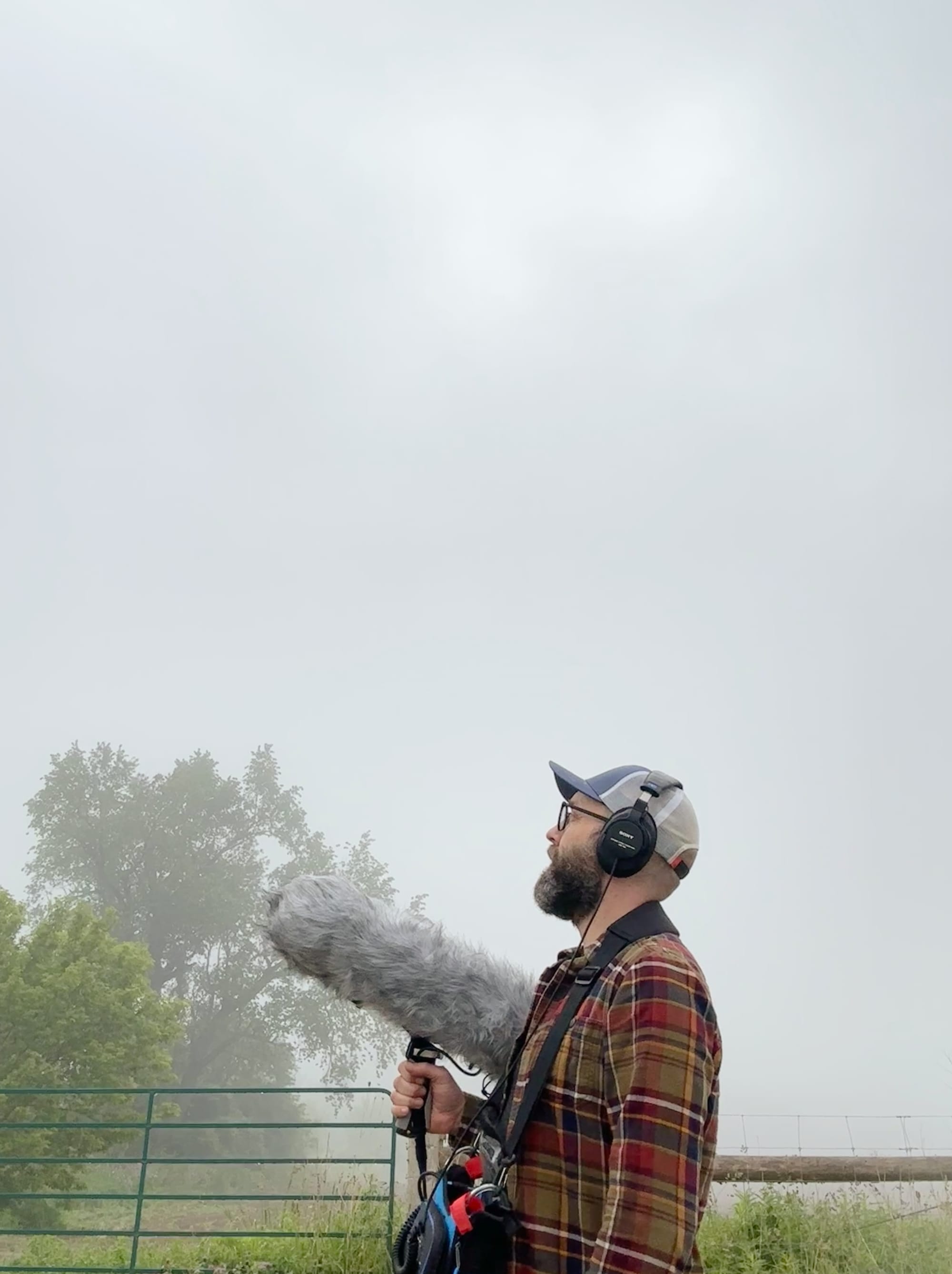
Today I'm delighted to present an interview with Douglas Tewskbury, a Canadian artist, musician, and media studies researcher at Niagara University, whose work largely focuses on the environmental and climate crisis, including how we engage with the natural world through literature, music, and other forms of cultural expression. In the 2010s, he studied the use of digital communications during movements like the Arab Spring and the Ferguson uprising. He's currently researching the environmental history of the Niagara region, a place of great natural beauty that was also home to the first modern power plant and, as a result, ravaged by industry over the century-plus that followed. It's a story that holds startling parallels to the devastations of modern resource extraction and the abuses of the current data center boom.
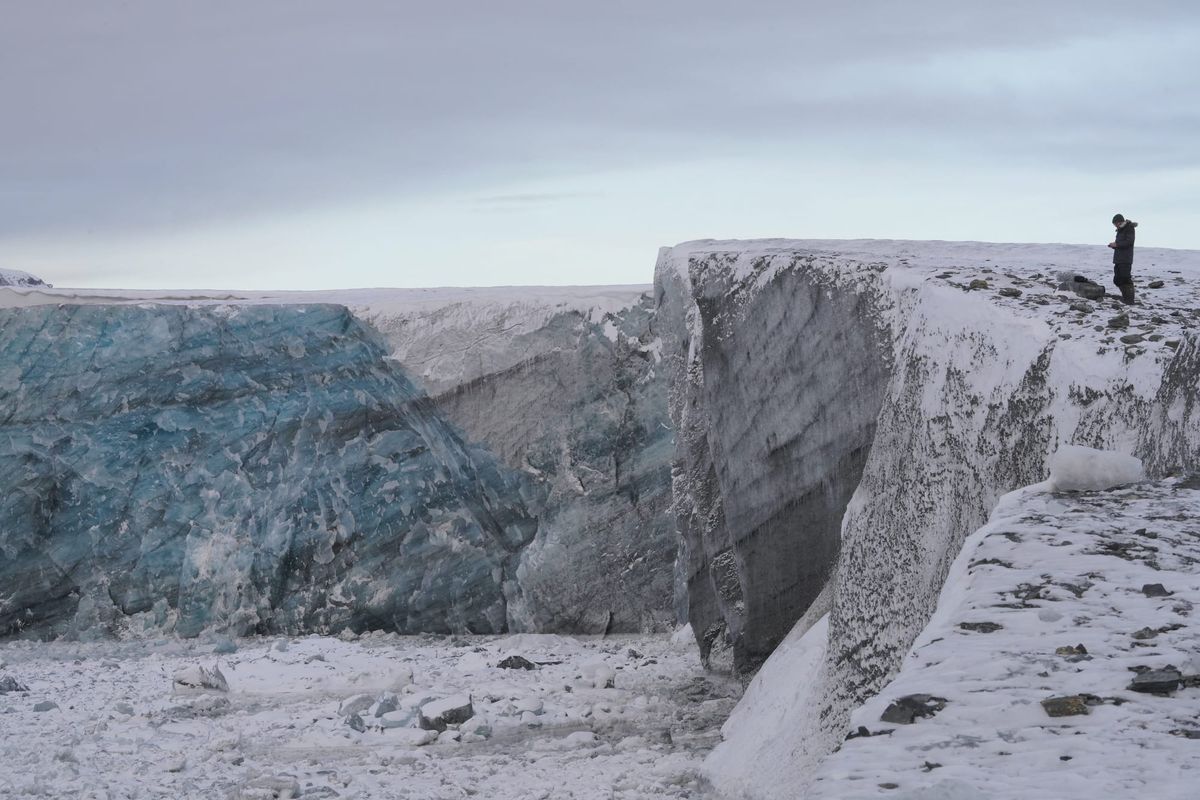
As an artist, Doug creates beautiful, melancholy sonic landscapes in the form of both ambient music recordings and sound installations in partnership with visual artists. Floes: Volumes I-IV, for example, is a three-hour series of long-form tape loops created with a Moog synthesizer, "deeply inspired by the natural world, and time spent in the slowness of the Canadian and Arctic winter." In 2023, he participated in The Arctic Circle Artist & Scientist Residency Program, exploring the high-Arctic Svalbard Archipelago and Arctic Ocean with a group of scholars and artists from a range of disciplines. He's currently preparing a piece for an upcoming installation in Iceland, which will combine audio and visual art to explore our relationship with plastic pollution.
Doug's from Arizona originally and we have known each other for a long time, but in the past 10 years or so, our interests have converged around similar topics, so we get on the phone every now and then to kick around ideas, talk about books and movies and music and the looming collapse of the livable world. I am so fond of Doug and think he's just an incredibly smart, creative, and all around cool guy. He had a new record drop recently, and has some exciting projects in the works, so it seemed like a good time to finally interview him for Crisis Palace.
Here's our convo, edited for length and clarity. Hope you enjoy.
This is in part a Tucson-focused newsletter. So maybe you can talk a little about your Arizona connection to get started?
I grew up in Arizona and lived there until I was 19 when I went away to university in Tennessee, and I haven't lived in Arizona for any extended period of time since then. So about 30 years I've been gone, but it's strange to me how Arizona looms so large in my consciousness, and my identity, and my formative years of growing up in a space where your relationship to land is much different than I think in a lot of other places.
I still have a deep place in my heart for Arizona, and especially the desert. I'm not a huge fan of the cities in Arizona, but whenever I get back, I try to spend as much time in the desert as possible, and that's something that's always been important to me. And even now, with with my kids, it's one of the highlights of our trip, and everybody looks forward to it. It's lots of time hiking whenever we end up back in Arizona to visit my folks or friends or other people.
Nice. And then, can you talk a little bit about where you live now and what you love about it?
Yeah, so my path over the years, like many academics, has taken me to a lot of different places for school and then for work. My path has kind of been one of heading eastward and northward for most of my my life since leaving Arizona, and currently I live in Canada, in Hamilton, Ontario, where I've lived for the past 15 or so years.
Hamilton's an interesting place. It's an industrial city. It's kind of like the Pittsburgh of Canada. You know, a steel town that is transitioning itself away from from heavy industry into more of the types of economies that many other post-industrial cities are: education, healthcare, creativity, and so on.
I love living in Hamilton because we're in the Great Lakes region, and it's a dense urban city that we live in, but you can drive 15 minutes and be out in nature pretty quickly, and the nature around here is really quite beautiful. Although it's very flat. I miss the mountains of the West.
So you're a professor at Niagara University. Can you tell me kind of a thumbnail sketch of what your interests are as an academic?
Yeah, I am a professor of media studies at Niagara University, which is in Niagara Falls, New York. So I cross the border from Ontario to New York to go to work. I teach a wide variety of things, and I have a little bit of a sandbox carved off for myself, where I teach media studies and film, and environmental studies, and art, and a number of other things. And it's a fantastic job. I'm really lucky. I have great students. I have great colleagues. It's a nice university. My classes are small, and I get to know my students really well. Teaching is the most rewarding part of my job by far. Because working with young folks, you get to learn a lot from them and you get to curate educational experiences.
In terms of my scholarship and creative practice, I've been teaching and researching environmental issues for a long time, but it wasn't until maybe six or so years ago that I started incorporating that into my music and art. It's been an awesome journey. I'm still really enjoying it. I get to be a researcher, I get to be an artist, and I get to be a teacher around my own interests, a lot of which deal with climate change, environmental issues, and humans' relationship to the natural world.
Would you say that most of your academic career is focused on the environment and climate change in some way?
I've gone through different chapters of my scholarship and research. In particular, there was a decade or so I wasn't researching environmental issues. I was looking at social movements and how social, democratic, and freedom movements were using social and mobile media technologies, and especially as they were moving into things like live streaming as those technologies were coming along—file sharing, BitTorrent networks—looking at new technologies of media production and consumption, particularly social media in the 2000s and 2010s.
That was a really exciting time with the Occupy movement, with the Arab Spring. There were a number of Canadian movements that were happening then. And in the earlier part of the 2010s, technology was an essential part of a lot of what was happening then, particularly things like Twitter and Facebook and YouTube and live streaming. It was a fun chapter to be researching in. But you know, by the mid- to late-2010s, my interest really was the environment and climate change.
I know it's been a little while since you have been working in that area, but was there something that you found particularly exciting or hopeful about the social justice movements of that time?
Totally, it was a really exciting moment because these leaderless, and I put that in big quotes, movements that were coming around were very empowering, and it felt like after 30-plus years of neoliberal normalcy that there was starting to be at least a little bit of an awakening to something like wealth inequality, to something like Black Lives Matter, to something like all of the movements of the Arab Spring, and oppression and injustice overall.
You had people who were starting to feel like they weren't alone, by seeing what other people had to say, by sharing videos, by seeing what was happening in Palestine, seeing what was happening in St. Louis, and people realizing that that oppression was shared, although it was enacted in different ways. And that the strategies for organizing and the methods that could be used for people to mobilize were similar. But also just that people weren't alone. I think that on social media around that time, a lot of people who felt isolated in their oppression, or that something just wasn't right, could recognize that other people felt the same way, and I think that was really validating.
Today, I think it's a little murkier. I think that we have entered the internet's awkward teenage years, where we're seeing a lot more isolation, a lot of misinformation, and now we're entering an era of AI, where I think we have a real challenge that's coming. I don't know how societies sustain themselves when nobody knows what's true and what's not. We're still in the infancy of that, and I think it's going to get a lot worse, and it's hard to not have things crack up when there's no shared sense of at least some baseline level of what's real and what's not. I think we're already there, but I think it's going to change a lot.
So this is all to say that it was a very exciting time. I think that the optimism of that time was important. I think there are some lasting legacies that come from it, but I think that the optimism and hope that was put into these sort of decentralized movements was a little too rosy. I think that a lot of the ideas that we were putting forth as researchers were valid at the time, but haven't quite come to fruition, and haven't been able to withstand the events that have happened since then. I'm a little less optimistic now about where things are going, like many people, and not just in terms of climate change, but in terms of democratic politics and politics worldwide.
Yeah I remember that time when Twitter was really kind of a liberatory platform in a lot of ways, but now I think that, even though organizers still use these corporate tech platforms pretty heavily, they do it very cautiously and more in service of in-person organizing.
There's still a lot of floundering on the internet when it comes to organizing. But I think there was a time when we thought this was going to free the world because we're removing all these communications restrictions. And now it's feeling like these are just going to be shortcuts in helping us do the real pick and shovel work.
I think you're right. A lot of this stuff can get weaponized very quickly. I mean, even in 2015, 2016, there were Russian trolls organizing Trump rallies, from the Internet Research Agency in Russia, organizing rallies nationwide in the U.S. It's easy to weaponize those things, and that was a decade ago.
There's a researcher Kirsty Robertson who's at Western University in Canada, and she wrote this amazing book that was called Tear Gas Epiphanies, and it's about the feeling when you experience being tear gassed that changes a lot of things for you, and that's an experience that you can't get on Twitter or Blue Sky or watching videos on YouTube. I think at the end of the day, you need mobilizations of people in space to make change, and I think that's always been true, and I think that will continue to be true.
You've been working on a paper about the environmental history of the Niagara region, and I know you probably are still processing it, and you maybe don't want to talk about it. But can you tell us a little bit about what some of your conclusions were?
Yeah, so when people think of Niagara Falls, they think of nature, they think of water, they think of purity, they think of the smallness of humans compared to the majesty of nature, and all of that is true in the falls. But what a lot of people don't know about is that the birthplace of modern electrical generation is Niagara Falls, New York. The first modern power plant in the world was built in Niagara Falls in 1895. A lot of heavy industry came around to access the electricity that was being generated there, which was both cheap and plentiful.
The chemical industries, the aluminum industries, the pesticide industries, lots of heavy industries were attracted there, and because there was no environmental regulation, they just dumped everything they had into the river or into the ground, or just let it go into the air. And so the region is actually one of the most polluted regions in North America. Less than a mile from the falls are several toxic waste dumps that are still there. Many have been remediated, but they're never going away. They don't remove the toxic waste. They just keep it from getting into the drinking water or the Great Lakes region.
So this area is just absolutely fascinating, these contradictions of nature and the toxic nightmare that is in this community. There's this arc of 125 years where there's great optimism for the future of progress and better living through technology and electrification and energy, and very quickly we see the normal operation of capitalism, where you don't want to pay to clean up your waste because that costs money, and you end up with a toxic nightmare.
It's a city where almost all of the chemical companies are gone now, but the toxic legacy remains. Nobody will ever be able to build anything there again. There are cancer clusters everywhere. Last month, they discovered another toxic waste dump under a residential community. This is a normal thing that happens in this community, and it's poor, and unemployment is high, and there are serious health concerns, and the jobs are gone.
It's the kind of place where the lesson to be taken is that whenever someone says we have to choose between jobs or the environment, that's a false choice, because there's a day of reckoning. There's a moment where the environmental question catches up with you, and Niagara Falls is the living proof of that today, where the jobs are gone and the environment's wrecked, and there's not a lot of hope left in that place.
It sounds like the story of global capitalism and extraction in a nutshell, in one community. And it's so familiar. It reminds me so much of the data center fights that we're having now, where we never stop having to make those false choices.
The money goes somewhere, and with the passage of time, it gets really hard to see where that money went. But the pollution went somewhere, and it's very easy to see where the pollution is.
Okay, let's pivot a little bit to art and culture. And I know one of the things that you teach is environmental humanities, which as I understand it is how culture expresses its relationship to the environment. I wonder if you can talk about why cultural and artistic representations of the environment are important as we're engaging with these issues.
The science on things like climate change and environmental destruction and habitat destruction and all of the terrible things that humans can do to the environment is very clear. There isn't a question about the negative effects that climate change will bring. We don't know exactly what they will be, but we know that we're hurting the environment through our carbon output and through the terrible things that we're doing to the Earth. However, the science is also very inaccessible to ordinary folks. They're not reading journal articles. They need to have the science translated to them, communicated to them in some form that makes sense, but also can tell a story because we are a storytelling species.
We understand the world through our journalism, through our art, through our literature, through our films and music and video games and TV shows and things like that. We understand time travel not through reading Einstein's peer-reviewed journal articles. We understand time travel through Back to the Future, and I think that the way that we understand environmental stories in terms of something like climate change, in particular, which is very abstract, is through our art. So environmental humanities is essentially about storytelling to the non-scientific public to help make sense of this very complicated situation that we've found ourselves in. Environmental humanities as an academic field is studying how environmental ideas are represented in our cultural forms.
Do you notice anything about how our how representations of the environment have changed over the years? Have you seen shifts or patterns in the way that we communicate about environmental issues?
I think it's that the storytelling has gotten more nuanced and less of a hammer, and more woven into stories that are human stories, which I actually think is the most powerful way to tell environmental stories. When you just tell someone you're going to die, we're all done, you know, what can you do with that? And that stuff is heavy-handed, and I don't want to hear that. Especially if you're already on board with a lot of those ideas.
It's like shows about COVID. It's been five, six years since COVID was at its peak, and I don't want to read anything where COVID is a plot point. I don't want to watch a movie about it. I don't want to listen to a song about it. I'm not there yet, and maybe I'll never get there, I don't know. But when it comes to something like environmental issues and how they're being represented in our cultural forms, I think that a lot of our storytellers are doing some very exciting things. The film Don't Look Up is one of the most streamed in Netflix history, and a lot of my students find it really powerful because I think farce is always a good way to tell a story, and I wish there was more of that.
But you know, documentary can be a powerful way of doing it. Telling smaller human stories that help us to understand how these things work. I think novels can be really powerful because they're so speculative of what might happen in the future, and they're rooted in imagination. And I think that we need a lot of imagination, not only to understand what's happening, but to get our way out of it.
I agree that climate communications have been fairly humorless for a long time, which I think has not served it very well. I also think back to a lot of those early climate change movies, like Day After Tomorrow, that were hitting people over the head—you know, very few people can sustain that kind of absorption of depressing information.
It's exhausting.
It is exhausting. You mentioned teaching and how much you enjoy it, and you interact with a lot of young people. I'm curious what their outlook on the climate crisis is right now. What do you hear from them? Do you feel like they have much optimism for the future?
It's hard to essentialize a group that big. They do have to write a lot in this class, and a lot of students, I think, really appreciate being given the opportunity to express themselves and their anxieties and their feelings around this kind of thing. For Generation Z and younger, there are a number of overlapping and intersecting crises, and climate change is one of the biggest ones. You have a world where the job market is not looking like it's going to be able to deliver the promises of the past. The housing market's wrecked. The rental market is wrecked. They're crushed in debt. The climate is wrecked. And now, you add AI on top of that, which is coming for a lot of the knowledge work and white collar jobs. Many people go to university for upward mobility and take on a large debt load in America in order to have that promise delivered—and that promise is somewhat bankrupt. I mean, that is really difficult. That's a difficult spot to be in.
I think that the generations that have come before them have intentionally and unintentionally lied to them about what will happen, but also have not delivered on the promise and the benefits that many people were given beforehand. There's always been problems and it's not like there was any super rosy moment for everybody, particularly marginalized folks. But I think generationally, something big is going to change, with some crisis moment for a generation that is feeling like their sense of hope for a better future is already pretty diminished. And I hope what that leads to is young people leading political change. Whether or not that happens remains to be seen, but that's where I put the most hope for change worldwide, especially with the issue of climate change, one of the most existential crises that we have.
I like what you were saying about how they see climate change as a much more intersectional issue than maybe a generation before did. I remember when Sunrise Movement, for example, was making statements about Gaza I think some old heads, disciplinarian type climate voices were like, don't muddy the waters, you're going to lose people. And I think for the people of that generation, there's no separation between these issues. It's not like you can't isolate it out as a purely environmental issue because it's many things.
I couldn't agree more. And I think one of the biggest issues on young people's minds is, should I have kids? Every semester that I've taught this class, which I've taught it four times now, that is a question that we end up spending a lot of time on. Enough so that I actually teach a couple chapters out of a book called Climate Anxiety and the Kid Question.
They're thinking about this. Is it okay? Is it moral to bring a child into a world that may not make it, but also when you have a lot of insecurity in all these areas of, not just climate, but jobs and housing and debt and money and all of these other things. You know, I empathize with where they're coming from. That is tough. We talk a lot about it in the class. The morality of it. It's the conversation that almost every year I think sparks the students' interest because it's clearly on their minds and nobody's talking about it.
One of the main ways that we think about whether we have hope for the future is thinking about what the generation beyond you is going to be doing. And it's become almost impossible to imagine that or envision it.
And this is why I think your essay on Children of Men was so powerful. I think a lot of that is woven into the themes of your analysis of that film.
Yeah, thank you. Okay, let's talk about your music and creative practice. So you mentioned that about six years ago was when you started folding your scholarly interests, your interest in the environment, into your work as an artist. What was the turning point where you first decided that this was something you were going to do?
In a way, starting to do music and art that was addressing environmental concerns and the climate crisis was an extension of what I research and teach. I'm thinking a lot about environmental theory and ideas and practice and what's happening in the world and how people are are engaging with the natural world, how I am engaging with the natural world. I've always been a musician in some form or another, but turning to these themes just felt like something I wanted to do. It just made sense to me. I found it deeply inspirational. The environmental philosophy and ideas that I was encountering just seemed to translate themselves well to creative inspiration.
You know, I'd played in a number of bands and musical groups throughout my life, but when I started doing my solo projects, where it was just me, that became somewhat of an outpouring of thinking about how to engage with these ideas. Ideas like, how do you try to recreate a hyperobject, which is a term from the theorist Timothy Morton, who writes about these big amorphous concepts that are difficult to grab onto, that you know are there and you can understand in very small ways, but they're harder to experience as a whole. So how do you represent that in a musical form, through thinking differently about composition? Or how do you turn to human voices, which is a medium that I really love working with, to communicate the beautiful and terrible things that we're doing to the planet? How do you engage with the slowness of the Canadian winter, the repetition of seasons, through working with tape loops and cycles and phases?
I know ambient music, using things like tape loops and field recordings, has been one of your big forms of expression, and I wonder what kind of opportunities ambient music allows you to explore that other forms of music might not?
Gosh, I don't know. It's a really good question. I don't actually listen to a whole lot of ambient music. Most of what I listen to these days is house music and the Grateful Dead, and a lot of live Can recordings. But as a musician, I just think that I like sound, and I like texture, and I like process.
I like having some sort of structure and rules around how I'm making things. And at the compositional level or the technical level, I like thinking about some sort of rule on how I'm going to make a thing, and that usually starts off the creative process. Whether it ends there is a different question. But ambient music is about texture and feel and affect, and I think that at the end of the day, these works are wordless, and they don't communicate meaning through something like syntax or whatever. They can technically be about anything to the listener, and that's all good. To me, many of these works are about environment and the climate crisis, but I think that one of the beautiful things about music, as a listener myself, is that you get to decide what music means to you, and that's a very personal decision.
Even though people will interpret your music in different ways, I wonder if in those records you had a goal, or something that you wanted to evoke, or what you hope people will experience when they're listening to it?
I guess it depends. It depends on the work, and not all of them are the same. You know, on my first record, I had a piano piece that I wrote that was an elegy to a dying glacier that I visited in Alaska a few years back, and the sadness of this thing that is very quickly disappearing. My daughter and I went to one of the visitor centers there, and watched a video that was like a one-minute timelapse of glacial retreat over seven years, and it was just shocking seeing how much the glacier had retreated, and I just wanted to write a piece to say goodbye, and that is a personal thing to me. I don't know how other people would know that story, maybe if they look up the name of the glacier or something.
But I don't know. I mean, that is something that was important to me to put out myself. Versus something like a few years ago, I released a large record called Floes that was three hours of music, and it's all very slow and very repetitious. It was recorded throughout the winter in Canada, a time when things do slow down and when the rhythms of things just get much slower, and are cyclical. The slowness of the Canadian winter informed not just how the work was made, where I was making it very systematically during those months, but it just seemed like the feeling of the work represented a moment in time and place on Earth.
As somebody who listens to your music, one thing I've always appreciated is there's a kind of a peacefulness and sadness in some ways. But it's not resignation. It's more like taking the time to sit with some heavy stuff. I don't know if you've thought about it that way, but there's kind of a calm sadness, I guess. I don't know, do you think your music is sad?
I do. Yeah, I do. I think it is sad. I think it's sad, but I hope that people find some beauty in it at the same time, in giving people something to not just listen to, but maybe to invest a little bit in. I like music that rewards investment either in time or attention or care, and I hope that people walk away from what I do musically feeling like the time was worth it. Because some of the works are quite long and slow and repetitive, but the calmness and the slowness and the repetition is the point.
But I do think there is a sadness to a lot of it. I think I feel sad about the state of the Earth and about our prospects as a species. In a lot of parts of my life, I think I approach that with some dark humor or irony, because I think a lot of this is outside of our control as individuals, and I'm not sure I know what to do. So certainly for people in my kids' generation, I'm deeply concerned. But I don't know. Sometimes I like having a Douglas Adams or Kurt Vonnegut approach. There's a lot of beauty when you read Vonnegut, and there's a lot of fun and there is a resigned sadness to the terrible things that we're capable of as humans, but there's also a hope that maybe things can get better with more reflection and appreciation of the beauty and the strangeness of anything being here at all.
It's kind of a cliche, but I always think about the concept of whistling in the graveyard. For one, the idea of making jokes and having fun in dark times or circumstances is to calm your own nervous system. But then, in a way you're almost manifesting calm, that something calm or enjoyable or fun can come out of this if I just sort of will it to be.
When I think about art in difficult times, I think about that. Because I find that when I'm in difficult circumstances, I tend to make a lot of jokes and goof around, or act like everything's going to be alright. And sometimes you just have to do that.
You're right. And it's one of the things I think in the art world that is not being done particularly well. Art takes itself very seriously, and when I'm doing museum and gallery work, I take myself very seriously. But a lot of the art that I really like tends to be more playful or irreverent or kind of fucking with people a little bit. I'm sure that there are a number of artists out there who are doing fun, dark climate art or environmental art. I do wish there was a little more of a sense of humor. Again, farce and fun can be a really effective way of having your message heard, and especially with something like environmental art.
I want to talk about some of the installations you've been doing lately, and that makes me think of the one you have planned that's going to be using plastic you collected when you were on your Arctic residency to make musical compositions. You can describe this better than I can, but there is something playful and kind of winky about that. Maybe you can talk a little bit about that project?
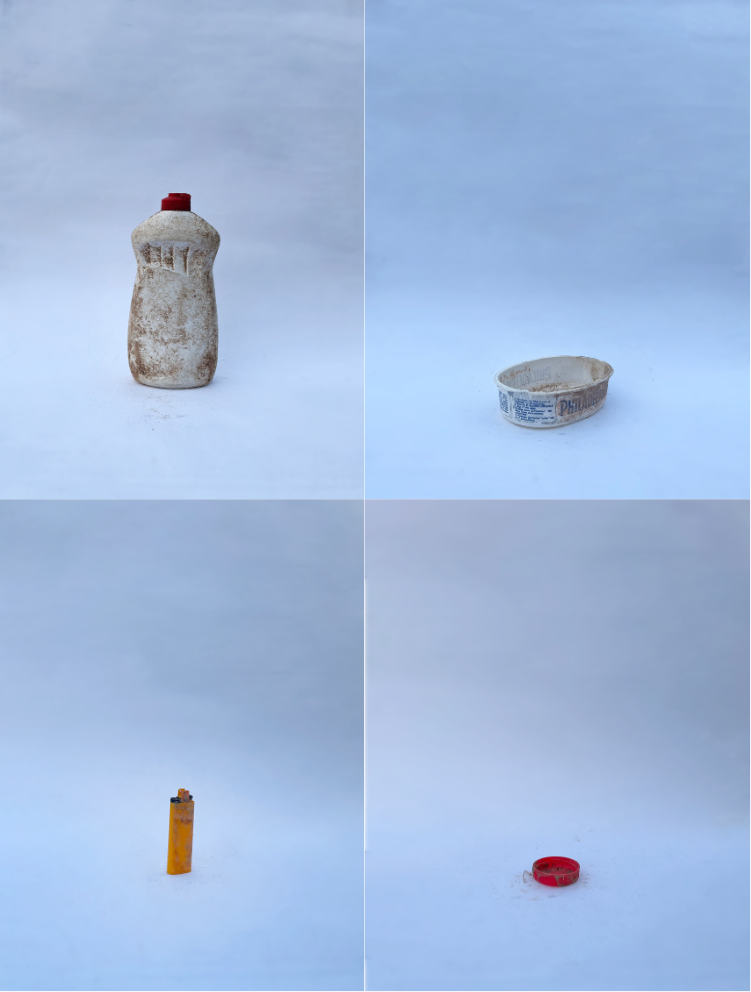
Right now, I'm working on a companion piece with artist Beili Liu, who's a predominantly visual artist, and she builds these large-scale sculptures with plastic pieces that are found in waterways from around the world, and she and I are working on companion pieces for an exhibition in Iceland that opens in November. She's building one of her large, stunning sculptures that hang tiny bits of plastic from the ceiling, and some things you recognize, and some things you don't. But it amasses this giant form, and if you get really close, you can recognize a Bic lighter or a piece of plastic from a plumbing fixture.
So I'm composing a piece that's using the sound of pieces of plastic that I collected during a residency in Svalbard in the high Arctic. I recorded the sound of 106 pieces of plastic that myself and others on this residency picked up during a two-hour walk. So it'll be a compositional piece, but also the sound of all 106 pieces of plastic will be released to the public for free as a sample library. I photographed all of them as well, so you can see what each piece that you're hearing looks like and what it was. So anybody will be able to download the sounds of Arctic plastic waste and create their own compositions through manipulating it in whatever software or hardware that they use. I'm really excited about this work. But also, you're right. It is fun. It's an unusual way of thinking about plastic and waste and music and art and composition. And I'm having a blast working on this.
Yeah, it's really cool, and it is similar to what you were saying about your music. There's something very sad about what you were able to collect in what we think of as a pristine environment that is just loaded with plastic garbage. But it's finding beauty in that too, the beauty in the decay and accumulation of trash essentially. Which I think is very thought provoking.
Sometimes projects like this one feel at least a tiny bit empowering. When I look at Beili's work, it's so powerful. You can't help but think about our relationship to plastic by looking at this incredible, unique piece of art that's made of thousands of pieces of bound plastic. It just brings home the gravity of the situation, and it changes your relationship to something as ubiquitous as plastic, and that doesn't happen very often.
Yeah, absolutely, and I think repurposing of things is a really important theme in lots of stuff. Especially any time you take something that has caused harm, or is a manifestation of harm, and turn it into anything other than what it was, it feels like a reclamation of power.
Or even something like Tim Heidecker and The Onion taking over Infowars. You know, it can be something like that, or sampling is a great example of reclamation, and you know, hearing sampling works that use politics, or like the work of the band Matmos, who have made works with plastics or other waste that get transformed into something different from what they were and forces people who engage with it, to carefully think about their relationship to the thing that it was.
It reminds me a little bit of '90s rap artists sampling clips from political speeches, which forces you to engage with them in a different way.
Yeah, like Public Enemy or D'Angelo's final record that he released in 2014 does this a number of times, and it's a powerful way of taking things that exist in the world and transforming them into new things that hopefully will shape people's political consciousness or creative consciousness or whatever.
Do you want to talk a little bit about other installations that you've done and what you've gained from them that's maybe a little bit different from your solo music work? Any that you're particularly proud of?
One of the most exciting things that I've done recently was curating a large museum exhibition at the Castellani Art Gallery at Niagara University, where I teach. I spent a year putting this together with the museum staff and eight artists. Several of their works were site-specific installations, and it was just so exciting doing this thing that was also very new for me, helping facilitate these artists to exhibit their work, because their creativity was just unmatched. Taking discarded children's toys and building them into large-scale sculptures, with things that I recognized from my childhood or my kids' childhood that were discarded. Or people filling bags of water that will bloom with the algae from the Niagara River over the next 10 months while this is here. It was very exciting.
In terms of my own work, I love working in museums and galleries as a sound artist. It's something that has been extremely rewarding in thinking differently about how people will engage in that space with the work, whatever it might be. A big part of it is using the work that's presented to you as inspiration, and thinking about how people will engage with it, how the other artists will engage with it, how the room will sound, what it will make people possibly feel.
Okay, I want to get to a close here, but maybe a couple big picture questions. So last time we talked, we were discussing the ideas of anger and forgiveness when it comes to climate change, and I'm kind of wondering where you are at with all of that. Can you describe to me your emotional engagement with the climate crisis? How are you feeling right now?
I think I feel worse about our prospects for the future than any other time in much of my adult life. I think with the rise of not only the Trump administration and its allies, but globally, the far rightward shift that's happened over the last year or two—the rise of authoritarians, the denial, but not even just denial, the lack of caring whether anybody else is doing anything, has me really worried. I think that it's a big step backwards, and the steps forward that we were making were not good enough anyway. And now, we're in real trouble. And I'm really concerned.
I'm concerned for my children, but I'm also concerned for everybody's children. I mean, it's all people on the planet, and it's going to take a generation to get us back on track, and I'm not sure that we have that kind of time. So I would say that more than anything else, I'm sad. I feel a level of defeatism, and yet continue to persist because what else can you do? I think we have to keep trying. We have to keep working. I think it's important, and I find a lot of hope in young people because I think many young people get it, but whether or not they'll have the opportunity to be in positions where they can help make coordinated policy, global decisions around these issues remains to be seen.
Is there anything that helps you cope? Anything that helps you work through that or make it endurable?
I'm actually a very happy person. There are a lot of things that bring me a lot of joy in life. I don't just sit around thinking about the darkness of our climate moment. I mean, it's something I care a lot about, and it's my vocation, and it flows its way into a lot of my creative and scholarly work, but I think it's important to keep that stuff in balance because life is supposed to bring you joy, and what good does sitting around moping do? So yeah, when there's progress, I celebrate that there's progress. I remain somewhat pessimistic for the long term hopes of our species, and I think a lot more progress needs to be made if we're going to make it, and I hope that happens. But you know, finding joy where you can find it is an important part of not looking too far into the darkness of where we're at in this moment.
Okay, so for a last question, I wonder if you have advice for people who feel overwhelmed or like things are coming at them a mile a minute. Do you have any advice for people in terms of how they should be engaging with these problems?
This actually goes back to a lot of the research I did earlier in my career that was looking at political organizing and social movements. I think it's really important for people to recognize that they're not alone, for people to recognize that how they feel is felt by other people, to talk to other people about these types of things.
And then finally, and this is the most important part, is actually getting involved in some form or another, whatever that means to people. It doesn't mean that you decide to go and get involved in environmental work and then everything changes overnight. I mean, change is small and it's incremental and you may not see it.
I do think that having a good sense of imagination, of futures that are not here but could be, is a really important part of political change, no matter what it is. It's a really dark moment with the shuttering of any program that was even remotely about curbing climate change, but times can change. I hope they do. Where I've found optimism has come through other people and doing things with and for other people to make the world better in some form or another. I think there's a lot of power in that, and it's an unfolding that hopefully will continue for people well into the future. I think it's probably the only way that change really happens, no matter what the issue, and I think that for something like the climate crisis, it's the only way that it's going to happen.